Smart Building Maturity: From Connected to Intelligent
After presenting across BICSI, Cisco Live Amsterdam, and a dozen customer workshops, here's the framework we use to help building owners understand where they are and where they're going.
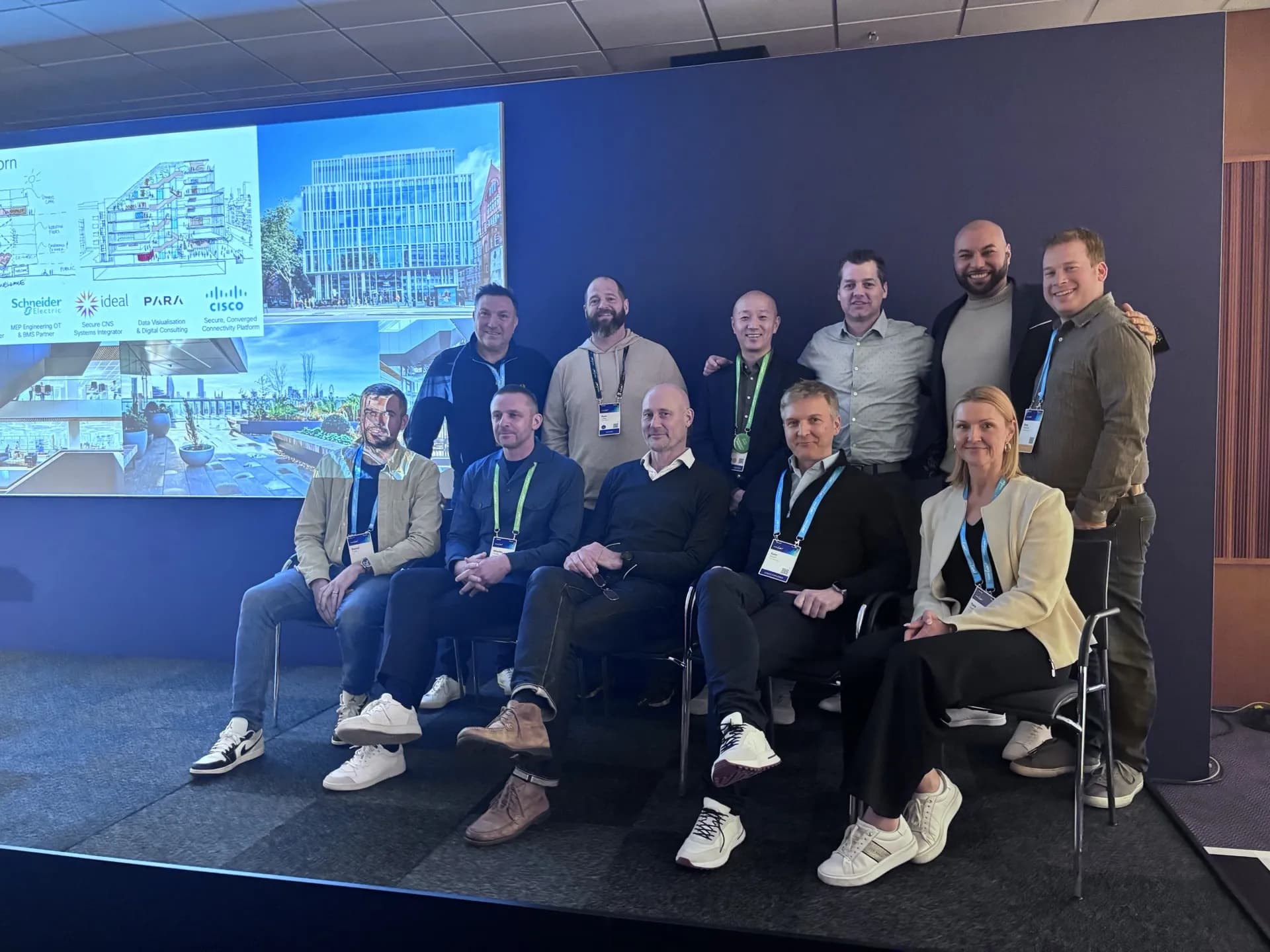
I was standing in a conference room at the Real Estate Accelerator in Austin when a CRE executive asked me a question I've heard a hundred times: "We have sensors everywhere. Why can't I get a straight answer about how my building is performing?"
She wasn't wrong. Her building had occupancy sensors, HVAC controls, lighting systems, security cameras, air quality monitors... all generating data. But each system had its own dashboard, its own vendor, its own data silo. She had a connected building. She didn't have an intelligent one.
That gap between "connected" and "intelligent" is where most building owners are stuck. And it's exactly what our Smart Building Maturity Model is designed to address.
The Problem With "Smart"
The building industry has a terminology problem. Every vendor calls their product "smart." A thermostat with a schedule is "smart." A light switch with an app is "smart." A $500 million campus with AI-driven space optimization is also "smart." The word has been so thoroughly diluted that it communicates almost nothing.
At Cisco Live Amsterdam, Andrew Lu and I presented a framework that cuts through this by defining clear maturity stages. The goal isn't to label buildings as good or bad. It's to give owners a map... where are you today, what's the next meaningful step, and what infrastructure do you need to get there.
Five Stages of Building Intelligence
Stage 1: Siloed. Individual building systems operate independently. HVAC, lighting, security, and access control each have their own network, their own management console, their own vendor relationship. Data exists but stays trapped in vertical silos. This is still the reality for most commercial buildings.
Stage 2: Connected. Building systems are brought onto a common IP network. This is the convergence step. Instead of separate overlay networks for each OT system, everything runs on a shared Ethernet fabric. You get centralized visibility and the beginning of cross-system data access. This is where the interesting conversations start.
Stage 3: Integrated. Systems don't just share a network... they share data. Your occupancy sensors inform your HVAC zones. Your lighting adjusts based on natural light and room bookings. Your security system knows which spaces are occupied. Integration breaks down the silos and enables the first real automation workflows.
Stage 4: Data-Driven. The building generates insights, not just data. Dashboards show space utilization trends over time. Energy consumption correlates with occupancy patterns. Predictive maintenance catches HVAC issues before they become tenant complaints. This is where building operations shift from reactive to proactive.
Stage 5: Intelligent. AI and agentic workflows optimize building operations continuously. The building doesn't just report on performance... it acts. Adjusting HVAC setpoints based on predicted occupancy. Routing maintenance crews based on sensor alerts. Surfacing investment recommendations based on cost-per-square-foot analytics. This is where most organizations aspire to be and very few have arrived.
The Infrastructure Foundation
Here's what surprises most CRE executives: the gap between Stage 1 and Stage 3 isn't a technology problem. It's an infrastructure and organizational problem.
The technology for convergence exists today. PoE can power and connect most building endpoints. Structured cabling can carry both data and power to every floor and zone. Network segmentation can keep OT systems secure while giving them IP connectivity.
The hard part? Getting IT and facilities to sit at the same table. The challenge with IT/OT convergence is generally not technical but process and stakeholder disruption. Having been through a few eras of convergence in the past 25 years... voice over IP, wireless, IoT... the pattern is always the same. The technology works. The turf wars are what slow things down.
At the Panduit consultant forum in Chicago, we walked MEP firms through exactly this: how to design convergence into a building from day one rather than bolting it on later. The cost difference is staggering. Running AC power to freestanding furniture in a post-tension structure costs a fortune. PoE to the same furniture over structured cabling? A fraction of the cost and infinitely more flexible.
Energy Networking: The New Frontier
The maturity model has a power dimension that didn't exist three years ago. Fault Managed Power and Class 4 DC distribution are adding a new layer to building infrastructure.
When I visited DC Systems in Amsterdam after Cisco Live, I demoed a short on a 350VDC system with no arc flash. A little nerve-wracking but it crystallized something: we're not just converging data networks anymore. We're converging power distribution.
A building with solar generation on the roof, battery storage in the basement, and DC-native endpoints throughout can eliminate entire stages of AC-to-DC conversion. Combine that with PoE for last-mile power and data delivery, and you have an energy networking architecture that's fundamentally more efficient than traditional AC distribution.
This is why Cisco and Panduit built a joint FMP solution. PoE handles the endpoints. FMP handles the backbone. Together they create a complete DC power distribution network managed through the same IT infrastructure that handles data.
Where Customers Are Today
After presenting across BICSI, Cisco Live Amsterdam, a dozen Real Estate Accelerator workshops, and the Nashville AI Week, I've had hundreds of conversations with building owners, MEP firms, integrators, and architects. Here's what I'm seeing:
Most large enterprises are at Stage 2... they've started converging networks but haven't broken the data silos. The ones who've made it to Stage 3 or 4 almost always had a champion who bridged IT and facilities teams early.
The leap from Stage 4 to Stage 5 is where AI enters. At Nashville AI Week, I presented on agentic workplaces... the idea that buildings are the second biggest expense on the balance sheet and generate a ton of data that isn't fully utilized. Exposing building systems to agentic workflows via MCP and A2A protocols is the next frontier.
The First Step
If you're managing a building portfolio and this framework resonates, the first step is honest assessment. Don't assume you're at Stage 3 because you bought "smart" products. Ask: can I get a single view of occupancy, energy, and environmental data across my portfolio right now?
If the answer is no, you know where to start. And the good news is that starting doesn't require a full rip-and-replace. It starts with the network you already have.