Your AI Assistant Should Know Your Data
Elevation's building intelligence chat now knows your assessment scores, building profiles, and domain gaps — turning a reference tool into a context-aware advisor.
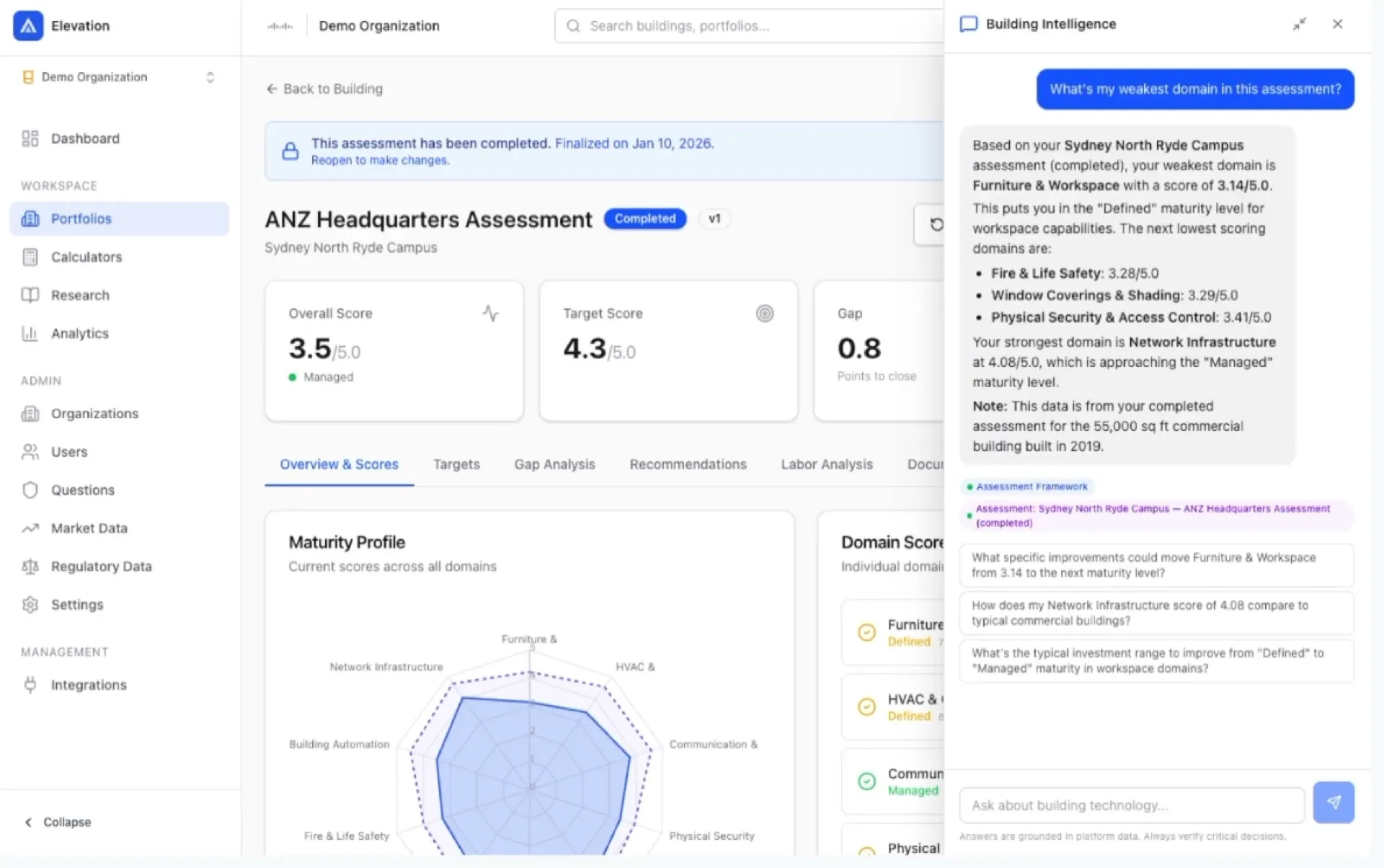
The chat assistant in Elevation could tell you everything about NEC code adoption in Texas, converged network reference architectures for Level 3 buildings, and ASHRAE climate zones in the Pacific Northwest. Ask it about electrical code in any of 50 states and it would give you the edition, the effective date, and whether FMP is permitted...all cited.
What it couldn't do was answer the question that matters most during an engagement: "How is my building doing?"
A consultant standing in front of a client, reviewing an assessment of their Sydney campus, asking the assistant "What's my weakest domain?"...would get a generic explanation of maturity levels instead of the answer sitting right there in the scored data. The platform knew the building scored 3.14/5.0 in Furniture & Workspace. The assistant didn't.
That changed this week.
The Problem With Reference-Only AI
Most AI assistants in vertical platforms are glorified search bars. They can look up reference data. They can answer general knowledge questions. They're useful in the way a textbook is useful...broad context, no specificity to your situation.
For smart building professionals, "useful like a textbook" isn't the bar. When you're presenting to a building owner, preparing a gap analysis for an MEP design team, or scoping a technology upgrade for a campus portfolio, the questions are never generic. They're always about this building, these scores, this client's priorities.
"Where should we focus investment to close the biggest maturity gaps?"
"How does this building compare to the rest of the portfolio?"
"What's changed since the last assessment?"
An assistant that can answer industry questions but not project-specific questions is an assistant you stop using after the first week.
What Changed
Elevation's Building Intelligence chat now has access to three layers of knowledge simultaneously:
Industry reference data — NEC code adoption across 50 states, energy pricing and tariff structures for 74+ regions, converged network reference architectures, CSI/RIBA/Uniclass standards mapping, HVAC and space utilization benchmarks, investment cost ranges for maturity transitions. The structured knowledge base that's been growing since launch.
Product and research knowledge — Ecosystem product catalogs, IEQ productivity benchmarks, climate zone configurations, material costs. Semantic search across embedded documents that finds relevant context even when you don't use the exact terminology.
Your actual assessment data — Domain scores, building profiles, assessment status, version history. Filtered to only show data you have permission to see. Scoped to the page you're on.
All three layers run in parallel. Every answer draws from whichever sources are relevant and cites them explicitly. Source chips at the bottom of each response link directly to the data...click a building assessment chip and you're on that assessment's page.
Context That Follows You
The assistant understands where you are in the platform and adjusts what it retrieves.
On the dashboard, ask "How are my buildings scoring?" and it pulls your 5 most recent assessments across all buildings. You get a portfolio-level view: which buildings are leading, which need attention, which domains are consistently strong or weak across the portfolio.
On an assessment page, ask "What's my weakest domain?" and it scopes to that specific assessment. The Sydney North Ryde Campus assessment scores 3.14/5.0 in Furniture & Workspace, with Fire & Life Safety and Window Coverings close behind. It references the building profile...55,000 square feet, commercial, built in 2019.
On a building page, it fetches all assessments for that building. Useful for tracking progress over time or comparing assessment versions.
The data is always fresh. No sync jobs, no stale caches. The assistant queries the same database the rest of the platform uses.
See It In Action
Here's a walkthrough of the three-phase pipeline running against real demo data — portfolio scoring from the dashboard, assessment-scoped queries, and all three knowledge layers contributing to a single answer:
Why This Matters for Client Engagements
The shift from reference tool to context-aware advisor changes how the platform fits into actual consulting workflows.
During assessments, the assessor can interrogate the data as they score. "I just scored HVAC at 2.8. How does that compare to the rest of the portfolio?" The assistant already has the context. No tab switching, no exporting to Excel to compare.
During client presentations, the assistant becomes a live research analyst. A client asks "What would it cost to move from Level 2 to Level 4 in electrical?" The answer draws from both industry investment benchmarks and the client's specific current scores. It's not hypothetical...it's grounded in their data.
Across portfolio management, consultants managing multiple buildings can ask cross-cutting questions from the dashboard. "Which of my buildings has the weakest network infrastructure?" comes back instantly with a ranked answer and links to each assessment.
Every answer is cited. Every source chip is clickable. Every piece of data is traceable back to either a scored assessment or an industry reference. No hallucination, no hand-waving...just the data the professional needs to make recommendations with confidence.
What's Next
This is the foundation for prescriptive intelligence. Now that the assistant can see your scores, building profile, and domain gaps, the next step is connecting it to the recommendations engine...letting it explain why a specific product family was recommended, what the expected ROI is based on your building's profile, and how the upgrade sequence should be phased.
The goal isn't to replace the consultant's judgment. It's to make sure the consultant always has the right data at their fingertips, in context, cited and ready for the client conversation.
The assistant knows your buildings now. That changes the kind of questions worth asking.